
The Odyssey
An epic and unmissable film

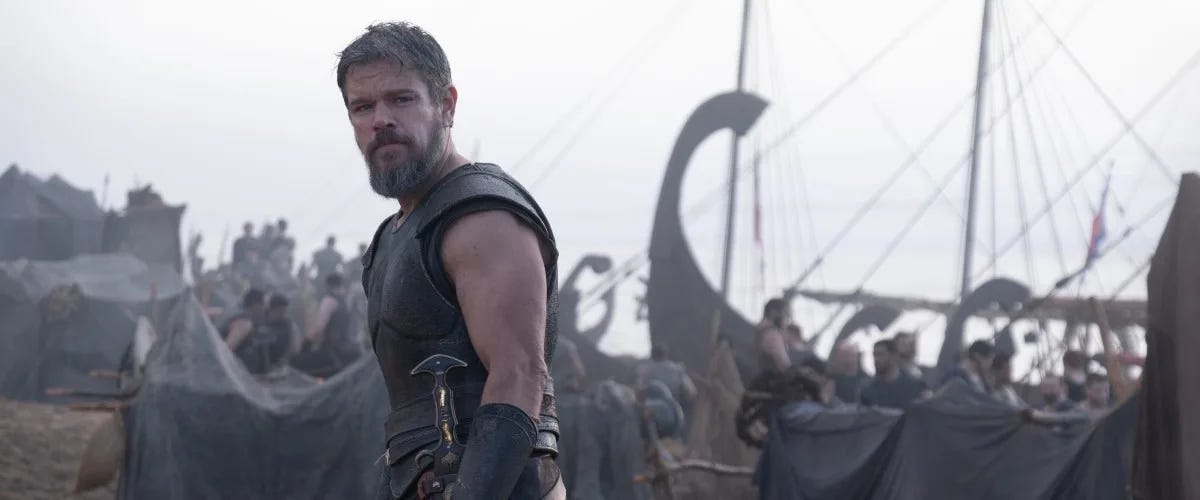
Christopher Nolan’s filmic masterpiece, The Odyssey, has been criticised for playing fast and loose with the details of Homer’s epic poem and for wokishly casting black actors in key roles. The Greeks, for good measure, are complaining that the actors in the film aren’t… Greek.
Talk about missing the point!! The film is not intended to be an accurate rendition of the text. Indeed, it draws upon more than one text — The Odyssey, The Iliad, and various other tales of ancient Greece. The point is rather to explore the grand themes that seem to Nolan to be embodied in the myth of Odysseus.
What Nolan is saying is that these great themes aren’t confined to one culture or one period in history. They are universal attributes of civilisation. That’s why Homer’s epics are among the core canonical texts of the West. So the fact that the characters are played by actors who are either black or white-skinned underlines that very point. Its lessons are for all of us.
And they’re about things that are foreign to the West’s self-centred, risk-averse, hedonistic culture, which has decided there’s no place for mystery, wonder or strangeness in its understanding of the world. The lessons of The Odyssey are about heroism and the terrible price that it entails, both to the hero himself and to others. They’re about doing the right thing, and having the moral courage to face up to the wrong that you’ve done. They’re about the complexities and ambiguities of human beings and the societies they form.
Odysseus, the great military leader whose daring and creative genius in creating the Trojan horse that enables the Greeks finally to defeat Troy, not only watches in horror the killing of women and children in the slaughter he has unleashed against his enemies but leads his own men into slaughter and then abandons their bodies without burial. He is cruel, ruthless and dishonest. He transgresses the codes of honour by which he knows he must live. But he can’t blame what he does on the gods. Consumed by guilt, his inability to face what he has wrought causes him to consume the drug of the lotus flower that ensures he cannot remember.
Odysseus’s terrible voyage back home is a voyage into guilt. He comes to realise the devastating truth articulated by his wife Penelope — herself an example of love and loyalty, steadfastness and moral courage — that in seeking to defend his civilisation, he himself became a threat to it. Redemption is to be achieved through his own love of his wife and his intention to atone for the wrong he did to his men.
The film isn’t perfect. Some lines at the very end are toe-curlingly cheesy. And some of the anachronisms grate.
These are minor points. The film is simply mesmerising: beautiful to look at, breathtaking, terrifying, spectacular, poignant. It conveys the sense of a story that’s on a massive scale. The absence of chronological sequence is deliberate: one scene merges into another as if in a dream or sometimes a nightmare. The emotional impact is strong and sustained from scene to scene. The film’s images remain in your mind like a haunting.
Amazingly, in this era of deep unseriousness, loss of reason and chronic aversion to reading, people are now reportedly flocking to read Homer’s epic for the first time. It shows the great craving by so many for purpose and meaning, for evidence of heroism and courage and the fortitude of the human spirit, to see good triumph over evil. And they want to connect to what they realise, however unclearly, is one of the building blocks of civilisation itself. The film has made them want to learn.
Ultimately, the film is saying, the purpose of Odysseus’s life is to be celebrated as a mythological figure so that successive generations can learn from his exploits as a heroic warrior.
Nolan has told us a story about the importance of stories that disturb and inspire us, that terrify and entertain us, that release our imaginations and activate our moral sense, that help us make sense of ourselves and our world.
The point of Homer’s epic is the epic itself. The point of Nolan’s epic film is to make sure we realise that.